



Metro West Real Estate Market Report — April 2026 | Wellesley, Newton, Needham & More

Charles King
Charles King is a top-producing real estate agent in Hingham, MA and a trusted Realtor serving the South Shore of Massachusetts, including Hanover, Hu...
Charles King is a top-producing real estate agent in Hingham, MA and a trusted Realtor serving the South Shore of Massachusetts, including Hanover, Hu...
Metro West Real Estate Market Report — April 2026 | Wellesley, Newton, Needham & More
Published: April 15, 2026 Data Period: October 15, 2025 – April 15, 2026 Source: MLSPIN, single family sales By: Charles King, Charles King Group
Metro West Real Estate Market Report: What the Numbers Tell Us Right Now
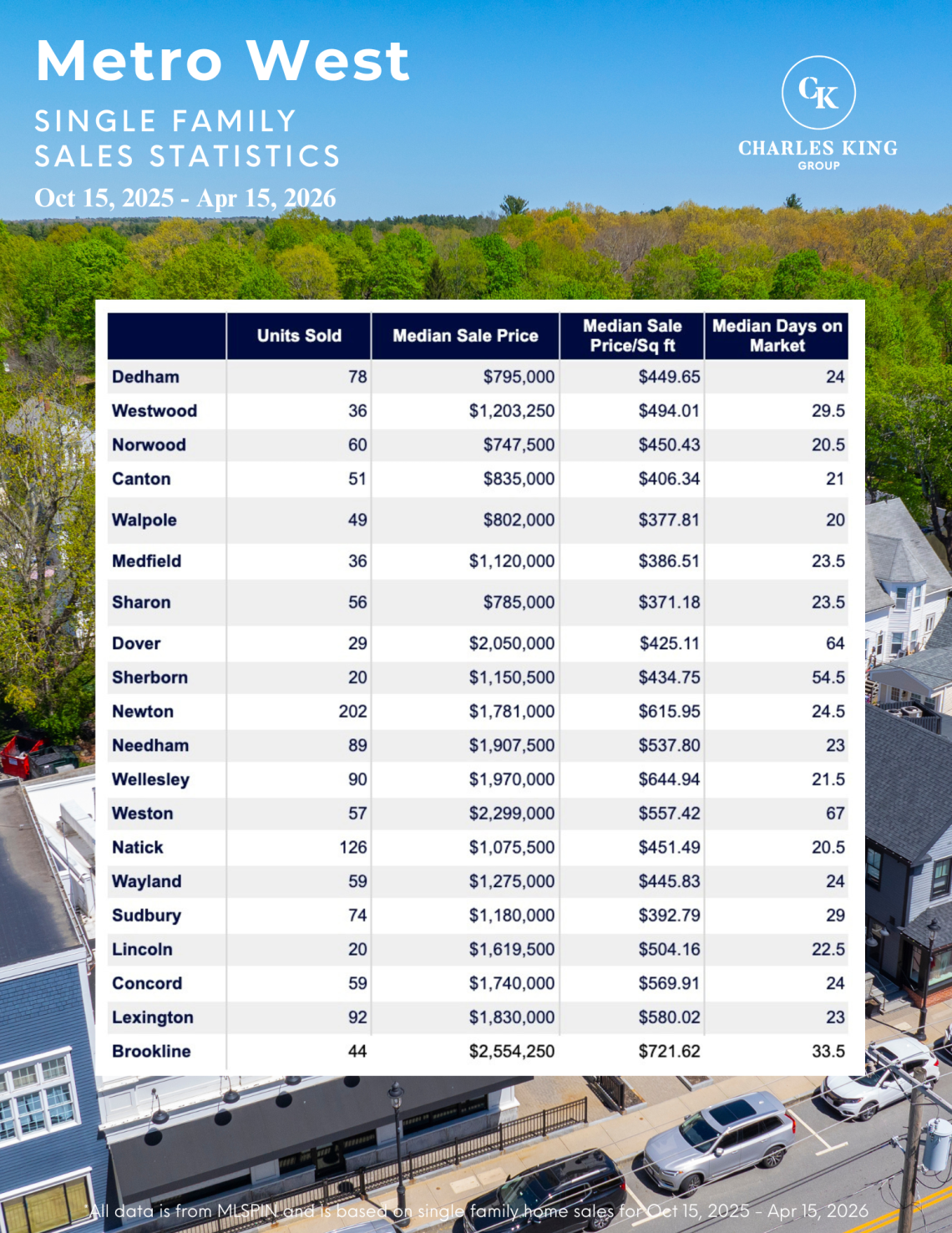
Wellesley, Newton, Needham, Westwood, and Weston set the pace for Metro West this spring — and the data from the past six months tells a clear story: this is still a market that rewards sellers and challenges buyers. Across the towns covered in this report (October 15, 2025 through April 15, 2026), median sale prices ranged from $747,500 in Norwood to $2,554,250 in Brookline, with most anchor markets absorbing inventory quickly and delivering strong returns on well-prepared listings. Whether you're considering a sale this spring or competing for a home in one of the region's top school districts, here's what the numbers actually mean for you.
The Headline Numbers
- $2,554,250 — Highest median sale price in the region (Brookline)
- $721.62/sq ft — Highest price per square foot in the region (Brookline)
- 202 units sold — Most transactions of any town in the report (Newton)
- 20 days — Fastest median days on market (Walpole)
- $1,970,000 — Wellesley median sale price
- 67 days — Longest median days on market (Weston)
What Stands Out — and What It Means
Brookline leads the region on price, and it's not close. At $2,554,250 median sale price and $721.62 per square foot, Brookline sits in a category of its own within Metro West. For context, Wellesley — the region's prestige anchor — comes in at $644.94 per square foot. Brookline's urban character, MBTA Green Line access, and proximity to Boston and Longwood Medical Area all contribute to premium pricing that outpaces even the most established suburban markets.
What it means: Sellers in Brookline hold significant pricing power. Buyers comparing Brookline to Wellesley or Newton should factor in the meaningful price-per-square-foot premium and what drives it — urban convenience and walkability are commanding a real premium right now.
Newton is the volume engine — and still priced like a luxury market. With 202 homes sold, Newton far outpaced every other town in transaction volume. Yet its median sale price still hit $1,781,000 with $615.95 per square foot and a median of 24.5 days on market. That's a rare combination: high volume and high prices moving quickly. Newton's diversity of neighborhoods — from Chestnut Hill to Newton Centre to Newtonville — gives buyers more options, but competition remains real across the board.
What it means: Don't mistake Newton's transaction volume for a softer market. More homes selling doesn't mean more negotiating leverage for buyers — it means more competition. Come pre-approved and ready to move.
Weston and Dover are a different category — and the days on market reflects it. Weston's 67-day and Dover's 64-day median figures stand out sharply against a region where most towns cleared homes in under 30 days. Both are large-lot, low-density markets with median prices above $2,000,000. The buyer pool for these properties is narrower by nature, and pricing precision matters more here than almost anywhere else in the region.
What it means: Longer days on market in Weston and Dover isn't a red flag — it's a structural feature of these markets. Sellers should calibrate expectations accordingly. Buyers have more room to deliberate without the same urgency they'd face in Newton or Wellesley.
Natick offers the most accessible entry point in Metro West's inner ring. With 126 homes sold, a median of $1,075,500, and just 20.5 days on market, Natick is busy and affordable by regional standards. It's one of the few towns in this report where buyers can enter the Metro West market below $1.1M and still find meaningful inventory. Commuter rail access on the Framingham/Worcester Line and proximity to the Mass Pike make it a logical landing spot for buyers priced out of Wellesley and Newton.
What it means: For buyers who want Metro West access without the $1.5M+ price tag, Natick is the most active, most accessible market in the region — but don't underestimate the competition. Homes are moving in three weeks.
Wellesley, Needham, and Lexington are all pricing above $1.8M and absorbing homes in under 24 days. These three towns — Wellesley at $1,970,000, Needham at $1,907,500, and Lexington at $1,830,000 — represent the core of Metro West's high-demand, top-school-district tier. All three moved homes in 21.5, 23, and 23 days respectively. The combination of strong school systems, established town centers, and Route 128/95 access keeps demand durable across market cycles.
What it means: If school district quality is a top priority, these three towns continue to deliver — but buyers must be prepared to compete. Contingency-light offers and financing certainty are table stakes in this price band.
Featured Town — Westwood
Westwood is easy to overlook in a conversation about Metro West — it doesn't have Newton's volume or Wellesley's name recognition. But the data makes a compelling case. Thirty-six homes changed hands at a median of $1,203,250, with a price per square foot of $494.01 and a median of 29.5 days on market. That's roughly $750,000 less than Wellesley with a $150 per square foot gap — and Westwood buyers still get access to top-ranked Norfolk County schools, easy Route 128 access, and a town character that balances suburban comfort with genuine community feel.
Inventory remains limited. Thirty-six transactions over six months means a thin pipeline — typically just a handful of active listings at any given time. For sellers, that scarcity is leverage. For buyers, it means preparation matters: when a well-priced Westwood home appears, competition is real and the window is short.
What it means: Westwood punches above its profile. If you're comparing it to Wellesley or Needham on price, the gap is significant — and the fundamentals support long-term value. Source: MLSPIN, October 2025–April 2026.
What This Means for Sellers in Wellesley, Newton, Needham, Westwood & Weston
The spring market is moving, and sellers across Metro West's anchor towns are entering it with real advantages. In Wellesley, Newton, Needham, and Lexington, homes are absorbing in under 25 days — that's a seller's window that rewards preparation over patience. The biggest risk right now isn't a slow market; it's an overpriced listing that sits long enough to lose momentum and invite low offers.
In Wellesley, where 90 homes sold at a median of $1,970,000, buyers are paying nearly $645 per square foot — but they're not paying blindly. Condition and presentation matter at this price level. A home that shows well, is priced accurately, and enters the market in early spring will see the most competitive activity.
Weston and Dover require a different approach. With median days on market of 67 and 64 respectively, sellers should anchor their strategy in pricing precision rather than timing leverage. The buyer pool for $2M+ large-lot properties is narrower and more deliberate. Getting the price right at the start matters far more than staging open houses every weekend.
Westwood sellers are well-positioned in a low-inventory environment. With only 36 transactions in the six-month period, well-priced Westwood listings face limited competition and motivated buyers.
What This Means for Buyers in Metro West
Buyers entering Metro West this spring need to come ready. In Newton, Wellesley, Needham, and Lexington, the median days on market runs between 21 and 24 days — meaning the most competitive homes are under contract before many buyers even schedule a second showing. Pre-approval isn't a nicety here; it's a prerequisite.
Financing contingencies are increasingly a negotiating liability in this market. If your offer is competing against a clean offer at nearly any price point in the region's top towns, contingencies can cost you the deal. Talk to your lender before you're in contract, not after.
If budget is a real constraint, Natick, Dedham, and Norwood offer meaningfully lower price points — $1,075,500, $795,000, and $747,500 respectively — while still delivering Metro West access, commuter rail proximity, and active markets. Don't overlook the towns on the edges of the region; they absorb homes just as quickly and at a fraction of the anchor-town cost.
For buyers targeting Weston or Dover, the longer days on market create more room for deliberate decision-making. That said, pricing in both markets reflects genuine scarcity — don't expect significant downward pressure just because a home has been listed longer than the regional average.
April 2026 Outlook
Metro West heads into mid-spring with the fundamentals that have defined this market for the past several years still firmly in place: limited inventory, durable demand from buyers prioritizing school districts and Route 128 access, and pricing that continues to hold or appreciate in the region's core towns. The seasonal tailwind of spring listings is already underway, but inventory is still being absorbed quickly — sellers who enter the market in April and May will face the most motivated, prepared buyer pool of the year.
Watch for Brookline and Newton to continue outperforming on price-per-square-foot metrics as city-to-suburb relocators keep those markets tight. Weston and Dover will remain their own category — patient, selective, and ultimately rewarding for buyers and sellers who approach them with the right strategy. If you're thinking about making a move in Metro West — whether you're buying your first home in Natick or selling in Wellesley — the conversation starts with the data, and we're happy to walk you through what it means for your specific situation.
Know Your Number
The market has changed. Your home's value has too. We track every sale in your area so you don't have to guess. Get a current valuation from a team that knows this market from the inside.
Frequently Asked Questions
What is the median home price in Wellesley right now?
The median single family sale price in Wellesley was $1,970,000 for the period October 15, 2025 through April 15, 2026. With 90 homes sold and a median price per square foot of $644.94, Wellesley remains one of the most competitive and expensive markets in the region. Buyers should expect to compete and come fully prepared before making an offer. Source: MLSPIN, October 2025–April 2026.
How fast are homes selling in Westwood?
In Westwood, single family homes sold in a median of 29.5 days on market during the period October 15, 2025 through April 15, 2026. With a median sale price of $1,203,250 and only 36 transactions, Westwood is a low-inventory, competitive market where well-priced homes move quickly. When a strong listing appears, the window is short. Source: MLSPIN, October 2025–April 2026.
What are homes selling for per square foot in Newton vs. Brookline?
Newton came in at $615.95 per square foot and Brookline led the entire Metro West region at $721.62 per square foot during the period October 15, 2025 through April 15, 2026. Brookline's premium reflects its urban character and proximity to Boston, while Newton's figure represents strong demand across a diverse range of neighborhoods and price points. Source: MLSPIN, October 2025–April 2026.
Is it a good time to sell in Metro West?
Yes — conditions favor sellers across most of Metro West heading into spring 2026. Median days on market ranged from 20 to 29.5 days across anchor towns including Walpole, Newton, Needham, and Wellesley, signaling sustained buyer demand and limited inventory. Sellers in Wellesley, Newton, Needham, and Brookline especially benefit from deep buyer pools and strong price-per-square-foot benchmarks. Source: MLSPIN, October 2025–April 2026.
Why did homes in Dover and Weston take so much longer to sell?
Dover posted a median of 64 days on market and Weston hit 67 days — both far above the regional average — during the period October 15, 2025 through April 15, 2026. These are lower-density, higher-acreage markets where median prices exceeded $2,000,000, meaning the buyer pool is naturally smaller and pricing precision matters more. Longer days on market in these towns reflects selectivity, not weakness. Source: MLSPIN, October 2025–April 2026.
What is the median home price in Needham?
The median single family sale price in Needham was $1,907,500 during the period October 15, 2025 through April 15, 2026. With 89 homes sold, a median of 23 days on market, and a price per square foot of $537.80, Needham continues to attract buyers seeking strong schools, community character, and proximity to Boston. Source: MLSPIN, October 2025–April 2026.
How does Natick compare to other Metro West towns for buyers on a budget?
Natick offers one of the most accessible entry points in Metro West, with a median sale price of $1,075,500 and a median price per square foot of $451.49 during the period October 15, 2025 through April 15, 2026. With 126 homes sold — the second highest volume in the region — and a median of just 20.5 days on market, Natick delivers meaningful value without sacrificing market activity or convenience. Source: MLSPIN, October 2025–April 2026.
All data sourced from MLSPIN. Single family home sales, October 15, 2025 – April 15, 2026. Published by the Charles King Group, Hingham, MA.
Charles King Group is a top-producing real estate team serving the South Shore (Hingham, Cohasset, Scituate, Norwell, Hanover, and surrounding towns), Boston, Cape Cod, Metro West, Northern Middlesex & the Merrimack Valley, and Bristol County. Brokered by Real Broker MA, LLC. Ranked in the top 1.5% of agents nationwide by Real Trends.