



17 Seller Questions Answered — November 2026 | What Hingham, Hanover & South Shore Sellers Need to Know

Charles King
Charles King is a top-producing real estate agent in Hingham, MA and a trusted Realtor serving the South Shore of Massachusetts, including Hanover, Hu...
Charles King is a top-producing real estate agent in Hingham, MA and a trusted Realtor serving the South Shore of Massachusetts, including Hanover, Hu...
17 Questions Every Hingham & Hanover Seller Asks — Answered by South Shore Agent Charles King
Published: November 17, 2026
By: Charles King, Charles King Group | Real Broker MA, LLC | Hingham, MA
Sources: Charles King agent observations, November 2026; Massachusetts DOR, IRS Publication 523, and Massachusetts Title 5 regulations where noted
If you’re thinking about selling in Hingham or Hanover, or anywhere else on the South Shore from Cohasset and Scituate to Norwell, you probably have the same questions every seller asks me. They usually come all at once, at the kitchen table. I grew up in Hingham and have sold homes here since 2012. These are the 17 questions I hear most, grouped by the worry behind them, with straight answers about how things actually work in our towns.
What Are the Key Numbers Every South Shore Seller Should Know?
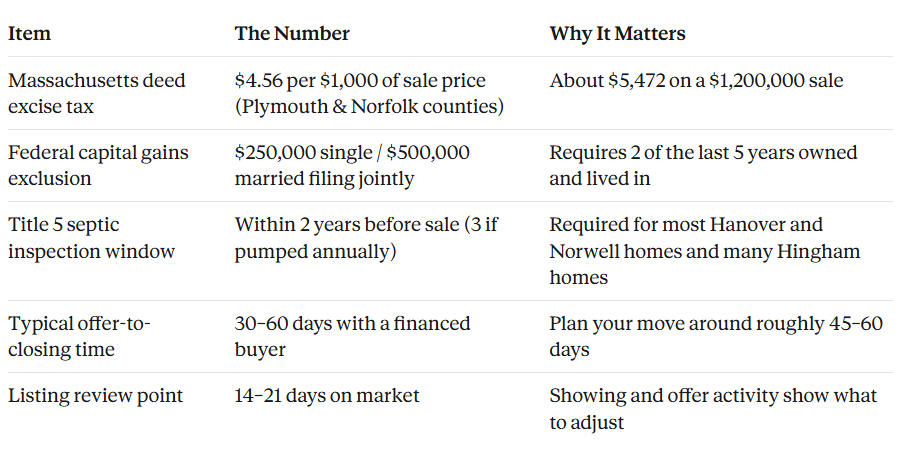
What it means: Your net proceeds, your timeline, and your pricing strategy can all be mapped out before you list. Sellers who do that work first make better decisions under pressure.
Part 1: Am I Leaving Money on the Table? Pricing and Proceeds Questions from Hingham & Hanover Sellers
1. What if my house doesn’t sell?
In Hingham and Hanover, a well-prepared home that’s priced right sells. When a house sits, the cause is almost always one of three things: price, presentation, or exposure. I set a review point at 14–21 days on market. If showings are strong but offers aren’t coming, the problem is price. If showings are thin, the problem is presentation or marketing reach. Then we adjust.
What it means: A stalled listing has a fixable cause. The real risk is waiting too long to fix it.
2. Is it a mistake to start high and come down later?
Usually, yes. Your most motivated buyers show up in the first two to three weeks. They’ve been waiting for a home like yours. If you price too high, they skip it. By the time you reduce, the listing looks stale and buyers start asking what’s wrong with it. On the South Shore, the homes that net the most are usually priced at or just under market value, which pulls in several buyers at once.
What it means: Pricing right on day one creates competition. Reducing later invites negotiation.
3. How much will I really walk away with?
Start with the sale price. Then subtract your mortgage payoff, commission, the Massachusetts deed excise tax ($4.56 per $1,000 of sale price in Plymouth County, which includes Hingham and Hanover), attorney fees, prorated property taxes, and any credits you agree to. Hanover sellers and many Hingham sellers should also budget for a Title 5 septic inspection. Every Massachusetts seller also needs a smoke and CO certificate from the local fire department.
What it means: Ask for a written net sheet before you list, not after you get an offer.
4. Will I owe capital gains tax when I sell?
Most primary-residence sellers won’t. Federal law excludes up to $250,000 of gain for single filers and $500,000 for married couples filing jointly, as long as you’ve owned the home and lived in it for at least two of the last five years. Massachusetts generally follows the same exclusion.
Long-time Hingham owners whose gains run past those limits should talk to a CPA early. Massachusetts taxes long-term gains as income, and the 4% surtax on income over roughly $1 million can apply.
What it means: Know your cost basis, including improvements, before you set a price. This is general information, not tax advice.
5. What’s my house actually worth?
Online estimates struggle in a town like Hingham. A house in Crow Point, one near Hingham Centre, and one off Route 3A can sit a mile apart and still be in different markets. Hanover has the same problem between established neighborhoods and newer subdivisions.
Real value comes from three things:
- Recent closed sales of truly similar homes
- Adjustments for condition, lot, and location
- What’s competing with you right now
Lot features matter too. Frontage, sewer access, and ADU potential can all add value; I explain why in my [Question 7 lot-size post].
What it means: A good pricing analysis is local and specific. An algorithm can’t walk through your house.
Part 2: Is Now the Right Time to Sell in Hingham or Hanover?
6. Should I sell now, or wait?
Waiting only pays if prices rise enough to beat your carrying costs, your taxes, and the price of the home you’re buying next. That’s hard to predict. Sell when your life says it’s time: a new job, a growing family, an empty nest. And if you’re also buying on the South Shore, remember that waiting for a higher sale price usually means paying a higher purchase price too.
What it means: Your own timing matters more than the market’s.
7. Will I lose money if I sell in the winter?
Not necessarily. December and January bring fewer buyers, but the ones out looking are serious. They’re often relocating or facing a deadline. There are also fewer competing listings. Nationally, new listings fell 7.5% year over year in October 2026 (Realtor.com). In Hingham and Hanover, a well-priced winter listing often gets more attention per buyer than it would in a crowded April. I cover the other side of this in my [fall negotiating window post].
What it means: Winter means less competition for you, not lower value. Get good photos taken before the snow.
8. How long will my house take to sell?
It depends on price point, condition, and season. Updated, well-priced homes in Hingham and Hanover often go under agreement within the first few weeks. Higher-end and waterfront homes in Hingham have a smaller buyer pool and can take longer. [INSERT: Median days on market, Hingham and Hanover single-family, last 6 months — MLSPIN]
What it means: Ask for days-on-market data for your town and price band, not for the whole South Shore.
9. Once I accept an offer, how long until it’s done?
In Massachusetts, a sale moves through five steps:
- Accepted offer
- Home inspection, usually within 7–10 days
- Signed Purchase and Sale Agreement, typically about two weeks after the offer
- Mortgage commitment
- Closing
With a financed buyer, most South Shore sales close 30–60 days after the offer is accepted. Cash buyers can move faster.
What it means: Plan your move around roughly 45 to 60 days, and start your Title 5 inspection and smoke certificate early.
Part 3: What Should I Fix Before I Sell — and What Should I Skip?
10. Should I fix it up, or sell it as is?
Fix what buyers will flag or what scares off lenders: leaks, safety issues, failed systems, and obvious deferred maintenance. Skip major renovations right before you sell, because Hingham and Hanover buyers often want to choose their own kitchen. Selling as is can make sense for estates or dated homes. Just expect buyers to price in the work, and usually for more than it actually costs.
What it means: Fix the things that cause fear. Leave the big projects to the buyer.
11. Which repairs are a waste of money?
These rarely return what they cost when done just before a sale:
- Full kitchen or bathroom remodels
- High-end finishes buyers may not like
- In-ground pools
- Major landscaping overhauls
Where money usually pays off: fresh neutral paint, refinished floors, updated light fixtures, a clean and well-kept exterior, and fixing anything an inspector will flag anyway.
What it means: Spend on first impressions and inspection items, not on taste.
12. Is staging worth the money?
In most cases, yes. It matters most for vacant homes and for the living room, kitchen, and primary bedroom. Most buyers see your home online first. Staging makes the photos stop the scroll and shows how each room works. In a Hingham colonial or a Hanover cape, a couple thousand dollars of staging and decluttering often pays for itself through faster offers and a stronger price.
What it means: Staging earns its money in the listing photos.
Part 4: Should I Sell, Rent, or Stay Put?
13. What if it sells and I have nowhere to go?
This worry is common, and it’s very solvable. You have several options:
- A longer closing date, negotiated with the buyer
- A contingency that makes your sale depend on finding your next home
- A post-closing rent-back (a use and occupancy agreement), so you can stay for a set period after closing
- A short-term furnished rental, as a bridge if the timing doesn’t line up
What it means: You don’t have to choose between selling and having a place to live. We plan the timing before you list.
14. Do I have to sell before I can buy?
No, though it depends on your finances. Your options include:
- A bridge loan
- A home equity line of credit set up before you list
- Buying with a home-sale contingency, which makes your offer weaker in competitive situations
- Carrying both mortgages for a short time
Talk to a lender first. Your equity in a Hingham or Hanover home may give you more room than you expect.
What it means: Get pre-approved for the buy-first scenario before you decide the order.
15. Should I rent it out instead of selling?
Run the real numbers: rent versus mortgage, taxes, insurance, maintenance, vacancy, and property management. Massachusetts is strict with landlords. Lead paint law applies to pre-1978 homes when children under six live there, and security deposits have firm handling rules. If you rent the home for more than three years, you can also lose the capital gains exclusion from Question 4.
What it means: Renting can build wealth, but it’s a business. Treat it like one before you commit.
16. Is it worth giving up my low mortgage rate?
The rate matters, but it isn’t the only number. Compare the total monthly payment on your next home to what you pay now. Then weigh it against what you’d gain: the right space, the right school district, less maintenance, or a shorter trip to the Greenbush line or the Hingham ferry. Many sellers put a larger down payment from their equity into the next home. That keeps the new loan smaller, even at a higher rate.
What it means: Don’t let a rate keep you in a house that no longer fits your life. Run the payment math with a lender. Rate scenarios are illustrative and should be verified with a lender.
Part 5: How Do I Know I’m Not Getting This Wrong?
17. How do I know if my agent has a real plan?
Ask for it in writing. A real plan covers:
- Pricing strategy: backed by recent closed sales in your town and neighborhood
- Preparation: which repairs, what staging, and when photos happen
- Marketing: where the listing appears, who it targets, and how it reaches buyers relocating to the South Shore
- Communication: how often you’ll hear from your agent, and when you’ll review results together
- Adjustment plan: what happens at 14 and 21 days if the results aren’t there
- Negotiation: how your agent will handle multiple offers, inspection requests, and appraisal gaps
What it means: If an agent can’t show you the plan, they don’t have one.
November 2026 Outlook
Heading into winter, there are fewer new listings competing for serious buyers. Nationally, new listings were down 7.5% year over year in October 2026 (Realtor.com). Well-prepared, well-priced homes in Hingham and Hanover still draw strong interest. The sellers who do best here start early: they know their number, their timeline, and their next move before the sign goes up. If you’re even six months out, now is the right time to start the conversation. Coffee in Hingham is on me.
Thinking about selling in Hingham, Hanover, or anywhere on the South Shore?
Get a custom pricing analysis and a written net sheet before you make a single decision.
Frequently Asked Questions
How much does it cost to sell a house in Hingham or Cohasset, MA?
Sellers in Hingham and Cohasset typically pay commission, attorney fees, prorated property taxes, a smoke and CO certificate, and the Massachusetts deed excise tax. The deed excise is $4.56 per $1,000 of sale price in both Plymouth County (Hingham) and Norfolk County (Cohasset), or about $5,472 on a $1,200,000 sale. Homes on private septic also need a Title 5 inspection. Sources: Massachusetts DOR deed excise rate; Charles King agent observations, November 2026.
Do I need a Title 5 inspection to sell my house in Hanover or Norwell?
Most likely, yes. Most homes in Hanover and Norwell use private septic systems, and Massachusetts Title 5 rules generally require an inspection within two years before the sale, or three years if the system has been pumped every year with records. Schedule it early, because a failed system can change your timeline and your price. Sources: Massachusetts Title 5 regulations (310 CMR 15.000); Charles King agent observations, November 2026.
Is it a good time to sell a house in Scituate or elsewhere on the South Shore?
The best time to sell is when your own plans call for it. Winter listings in Scituate, Hingham, Hanover, and across the South Shore face fewer competing homes, and nationally new listings fell 7.5% year over year in October 2026. Spring brings more buyers but also more competition. Sources: Realtor.com, October 2026; Charles King agent observations, November 2026.
How long does it take to close on a house in Massachusetts after accepting an offer?
With a financed buyer, most South Shore sales close 30 to 60 days after the offer is accepted. The usual sequence is the home inspection (7 to 10 days), a signed Purchase and Sale Agreement (about two weeks after the offer), mortgage commitment, then closing. Cash sales can close faster. Source: Charles King agent observations, November 2026.
Will I pay capital gains tax when I sell my home in Hingham?
Most primary-residence sellers won’t. Federal law excludes up to $250,000 of gain for single filers and $500,000 for married couples filing jointly who owned and lived in the home for two of the last five years, and Massachusetts generally follows that exclusion. Long-time Hingham owners with gains above those limits should talk to a CPA before listing. Sources: IRS Publication 523; Massachusetts DOR guidance, 2026.
Should I renovate my house before selling in Hingham or Hanover?
Usually not a major renovation. Hingham and Hanover buyers often want to choose their own kitchen and bath finishes, and pre-sale remodels rarely return their cost. Focus on paint, refinished floors, lighting, curb appeal, and anything a home inspector would flag. Source: Charles King agent observations, November 2026.
Can I stay in my home after it sells in Massachusetts?
Yes, if it’s negotiated into the deal. A post-closing rent-back, written as a use and occupancy agreement, lets South Shore sellers stay for a set period after closing while they finish buying or moving. A longer closing date or a contingency on finding your next home are other options. Source: Charles King agent observations, November 2026.